
We’ve all had that moment. Your dog absolutely knows the skill. You’ve trained it. Repped it. Seen it look beautiful in practice. Then you show up to class, a trial, or a busy environment and suddenly… everything changes.
Focus disappears.
The start line gets sticky or fails.
The barking starts.
Responses become frantic or inconsistent.
Your dog feels disconnected.
And somewhere in the middle of it, frustration sneaks in because you know your dog can do this. But what if the issue isn’t knowledge? What if the issue is access to the prefrontal cortex?
Because there’s a big difference between a dog knowing a skill and a dog being able to access that skill when their nervous system is overloaded.
That difference matters more than most people realize.
When the Nervous System Gets Loud
Performance dogs are athletes, but they are also emotional beings navigating stimulating environments.
New sounds.
Movement.
Pressure.
Anticipation.
Excitement.
Environmental change.
All of that creates input. And for some dogs, that input starts stacking faster than they can organize it.
I call this neurological noise. Learn more about this with me here
Neurological noise is the internal static that makes thinking harder.
When the nervous system becomes overloaded, dogs often struggle to regulate arousal, process information clearly, and make thoughtful decisions. The brain becomes busy sorting through too much at once, and suddenly the dog who looked brilliant in training feels scattered, impulsive, or overwhelmed.
This is often when we see:
- barking or vocalizing
- frantic spastic movement
- sticky starts / hesitation / broken start lines
- impulsive choices
- loss of focus
- inconsistent responses
- difficulty settling or recovering after excitement
And here’s the important part:
This doesn’t automatically mean your training failed. A lot of the time, the behavior is still there. Your dog just can’t access it in that moment. Because regulation broke down first.
The Goal Isn’t Less Energy / Arousal
I think this is where people sometimes misunderstand arousal. The goal isn’t to create flat dogs. The goal isn’t to suppress arousal. And the answer definitely isn’t always “just exercise them more.” More stimulation does not always equal better regulation. In fact, for some dogs, adding more excitement to an already overloaded nervous system simply creates more noise.
What we actually want is organized arousal. Dogs who can feel excitement without tipping over into chaotic arousal. Dogs who can stay thoughtful while still being engaged. Dogs who can recover quickly after stress instead of spiraling.Dogs who can pause, process, and make better choices. That kind of performance doesn’t happen by accident.
It’s built.
Why Purposeful Fitness Pattern Games Matter
One of the reasons I love pattern fitness is because they create predictability.
Predictability lowers stress.
When dogs understand the flow of an exercise, the nervous system can stop scanning for uncertainty and start settling into organization.
Purposeful Pattern work helps dogs:
- slow down mentally
- regulate emotions
- build focus around distraction
- develop predictability and confidence
- stay connected to the handler under arousal
Instead of reacting to everything around them, dogs start learning to think.
To pause. “CONTROLLED ENERGY”
To process. “THINK”
To organize themselves. “PROCESS”
And for dogs who struggle with self-regulation, that shift can be huge.
Why Conditioning Matters
Conditioning is another piece of this puzzle that often gets overlooked. I’m not talking about simply “burning energy.” I’m talking about intentional movement. Purposeful exercises that help dogs learn how to organize their bodies and minds at the same time. Because body awareness affects confidence. Coordination affects movement quality. Stability affects control. And thoughtful movement affects regulation.
When dogs learn how to move with more proprioception, they often stop moving through life in a frantic, disconnected way.
We start seeing:
- better balance and coordination
- improved body awareness
- stronger focus
- calmer movement patterns
- more confidence in challenging environments
- better recovery after excitement or stress
The physical and emotional systems are deeply connected.
Dogs who feel more organized in their bodies often become more organized in their responses. And for performance dogs, that matters. Because performance isn’t just about skill. It’s about being able to access skill when it counts.
Sometimes the Fastest Way Forward Looking Back
This is the part nobody loves hearing. Sometimes progress looks like revisiting foundation work. Sometimes the answer isn’t drilling harder. Sometimes the answer is helping the nervous system become more organized first. That means paying attention to details. Learning to notice the subtle signs before things unravel. Recognizing when arousal is climbing.
Asking better questions:
What does my dog need right now?
What skill would make this easier?
Where is regulation breaking down?
Because when we stop viewing non-regulated behavior as disobedience and start seeing it as information, everything changes. Training becomes clearer. Dogs become more successful. And teams start feeling less frustrated and more connected.
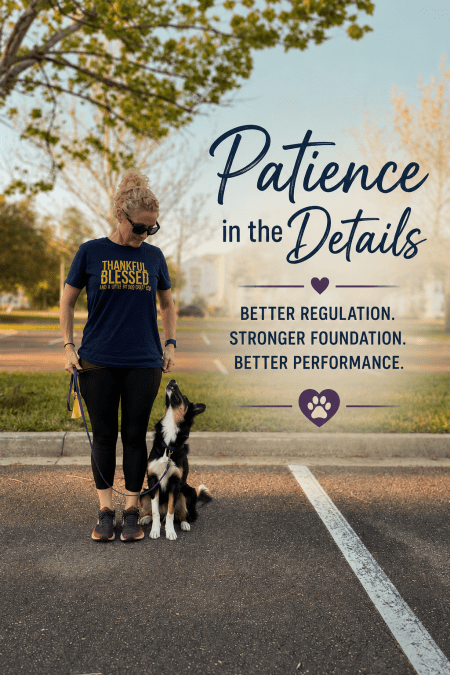
Patience in the Details
This is exactly why I created Patience in the Details.
This class is designed to help dogs build regulation, precision, and thoughtful movement through a combination of purposeful fitness pattern games with intentional conditioning exercises.
Each week blends mental focus work with physical awareness training to help dogs:
- lower neurological noise
- regulate arousal more effectively
- improve focus and emotional control
- build confidence in stimulating environments
- develop better coordination and body awareness
- move more thoughtfully and precisely
Whether you have a sport dog needing better access to skills under pressure, a dog who struggles with self-regulation, or a dog who simply benefits from more thoughtful movement and confidence-building, this class focuses on the foundations that matter most.
Because better performance starts long before the ring.
It starts in the details.
Enrollment opens May 22nd
Limited working spots available Join me here